Building GDPR-safe AI search for public information
A real-world experiment in simplifying complex regulation using EU-based inference
Introduction: when information exists but usability fails
Across many domains, information is not scarce — it is fragmented.
Public regulations, guidelines, and instructions often exist across multiple sources, each authoritative in isolation. Municipal websites, industry portals, and official documents all contain correct information, yet users still struggle to find clear answers.
This article describes a real-world experiment in simplifying access to complex regulatory information using retrieval-augmented generation (RAG) and private EU-based AI inference. The focus is not on replacing existing authorities, but on making national-level access possible in a landscape dominated by local and institutional ownership.
Why inference location matters before anything else
Before discussing use cases, architecture, or SEO, one constraint had to be addressed: where AI inference runs.
Public-facing applications that deal with regulations, civic guidance, or citizen-facing information must operate within clear data boundaries. Even when the data itself is public, user queries and interaction patterns are not.
That requirement led to the creation of Juicefactory.ai — a private AI inference layer operating entirely within the EU. Its scope is intentionally narrow:
- inference only
- no storage of personal data
- no customer data used for training
- OpenAI-compatible interfaces for integration simplicity
Juicefactory is not positioned as an application platform, but as infrastructure: a controllable runtime for AI inference where compliance is explicit rather than assumed.
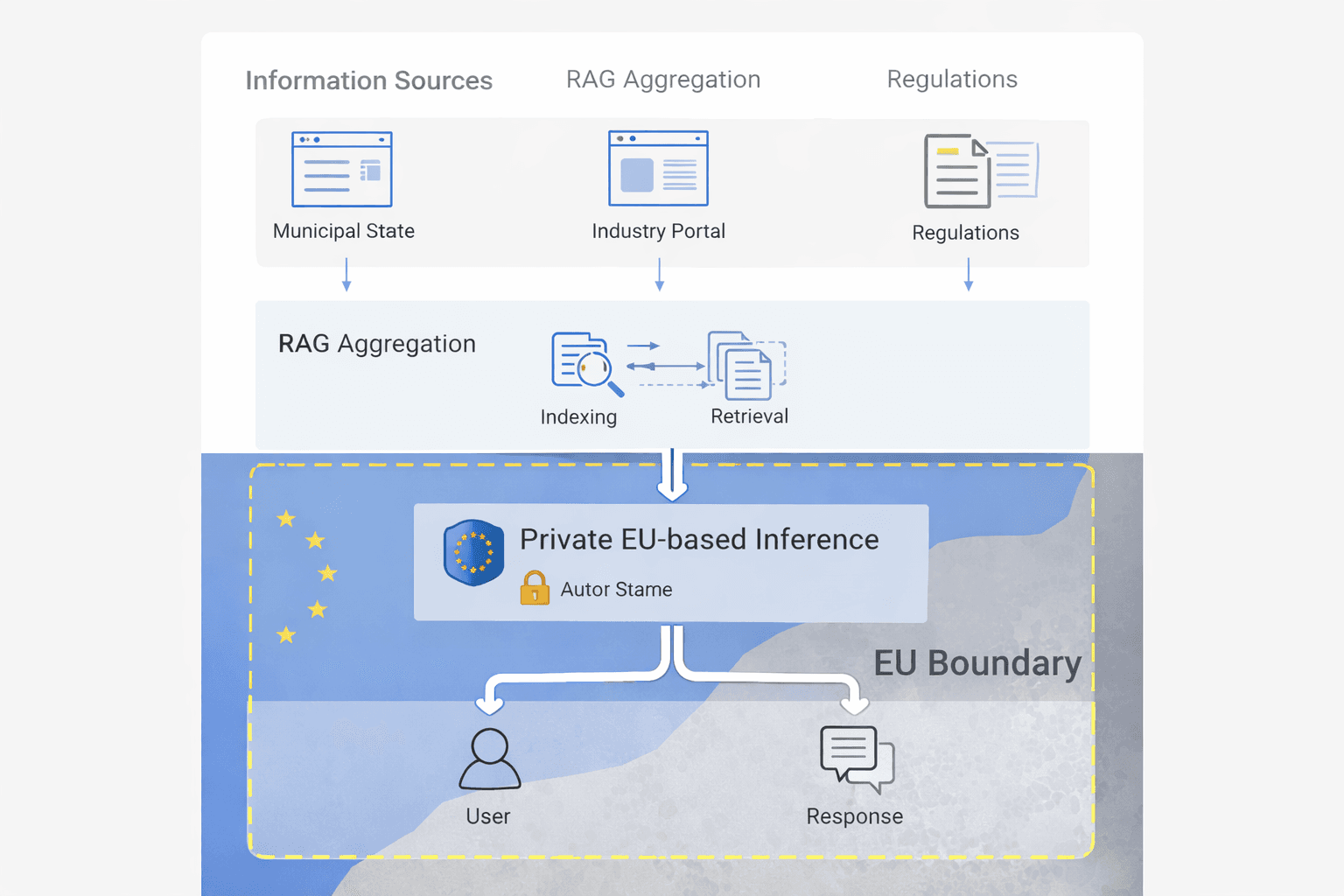
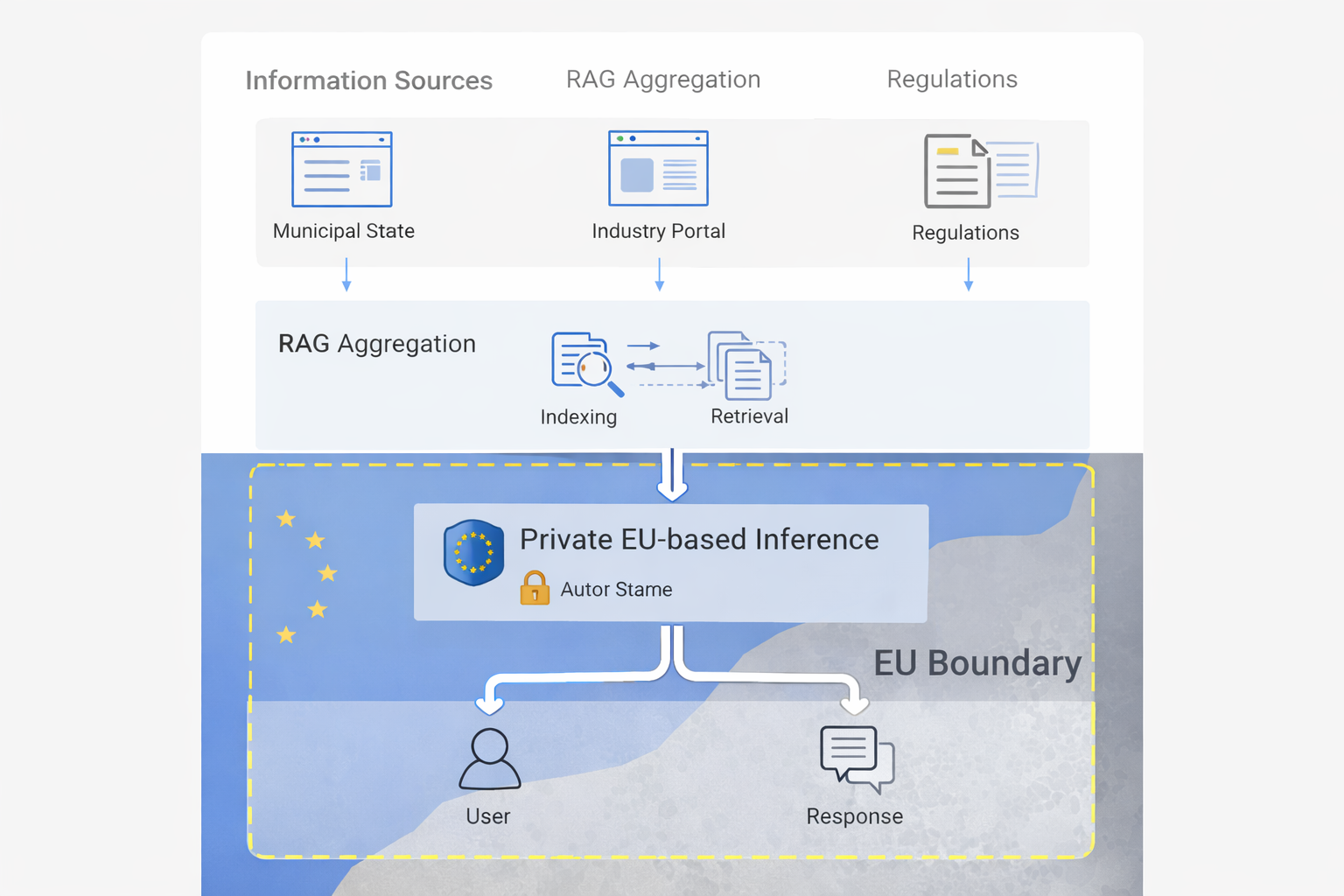 Architecture showing how public information sources flow through RAG aggregation into private EU-based inference, maintaining clear data boundaries.
Case study: Sopinfo.se — simplifying a nationally fragmented problem
Sopinfo.se is not a traditional product, nor a commercial service. It is an experiment.
In Sweden, responsibility for waste management and recycling information is highly decentralized. Municipalities publish their own rules and guidance. Industry partners maintain separate portals — such as sopor.nu — which contain accurate information but are not always easy to navigate.
The result is a classic usability gap:
- the information exists
- it is often correct
- but it requires many clicks, local knowledge, or prior context to access
Sopinfo.se was created to explore whether this fragmentation could be simplified at a national level, without attempting to replace local authority or institutional ownership.
The goal is to help citizens understand what applies to them, faster.
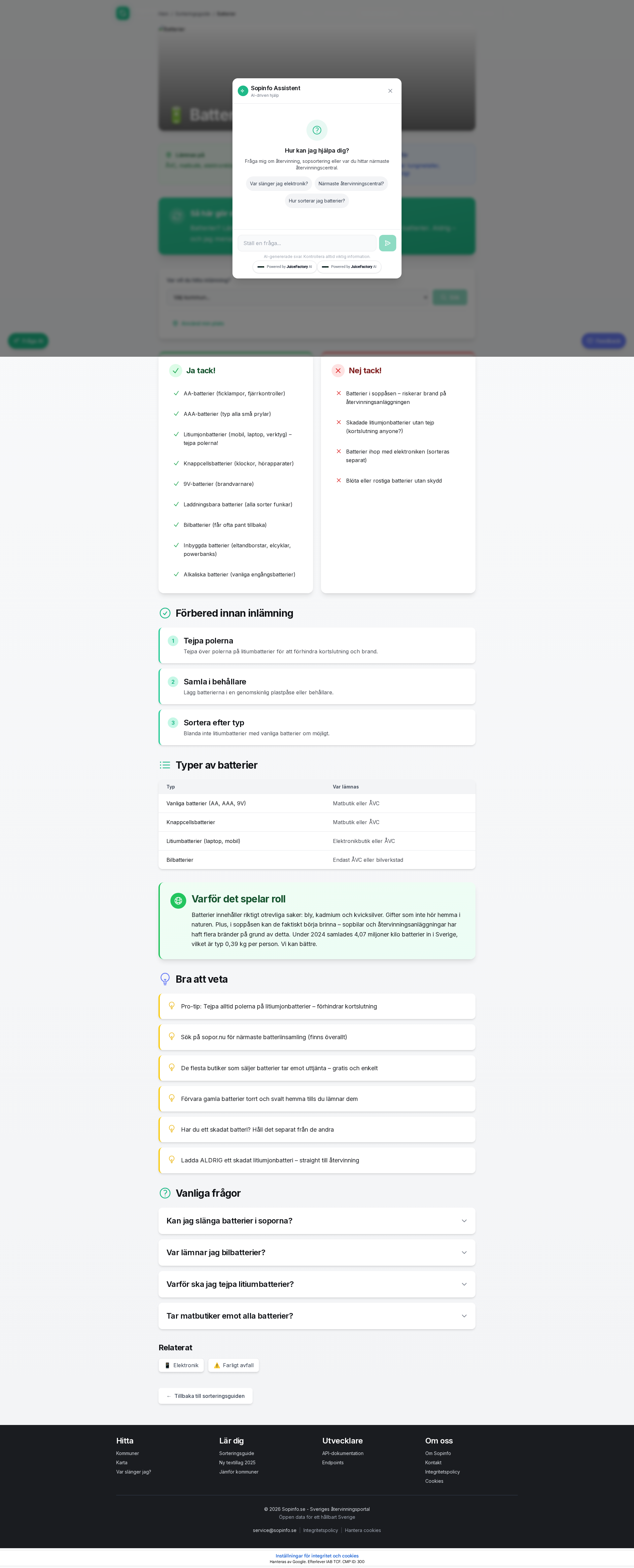 Real screenshot showing Sopinfo.se AI chat responding to a question about battery recycling in Stockholm, with source attribution.
An experiment in national usability, not local authority
This approach deliberately enters a red ocean.
Local authority already exists. Municipalities and industry organizations own the data. Competing with them on local completeness would be ineffective and unnecessary.
Instead, the experiment focuses on:
- national-level discoverability
- simplified access paths
- user intent rather than document structure
The hypothesis is that there is room for a complementary layer: one that helps users navigate across authorities rather than within a single one.
This is not about ranking above municipalities. It is about helping users reach them.
Technical architecture: RAG as an aggregation layer
The technical setup reflects this philosophy.
Core components
- Qdrant is used to store and index content from multiple sources
- Information is embedded using Qwen3 4B embeddings
- User questions and response synthesis are handled by Qwen3 30B VL
- All inference runs on private EU-based infrastructure, provided by Juicefactory.ai
The system does not invent rules. It retrieves, contextualizes, and points users to the correct authoritative source.
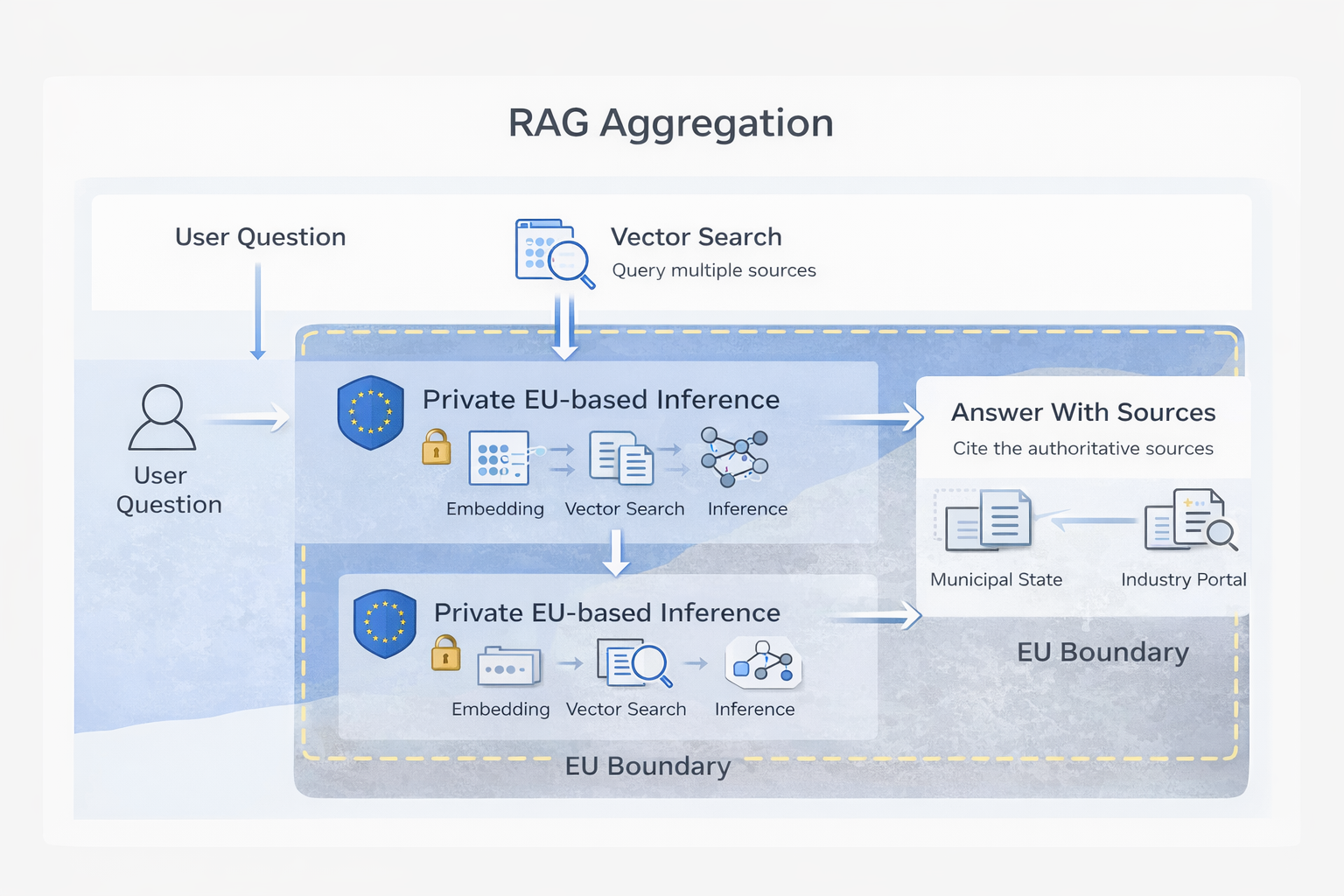 Technical flow showing how user questions are processed through vector search, private EU-based inference, and returned with source attribution.
SEO as a side effect, not the primary goal
Although Sopinfo.se is an experiment in usability, it also provides an opportunity to explore SEO in competitive, authority-heavy domains.
By:
- answering real user questions
- linking back to authoritative sources
- observing query patterns
the system naturally surfaces long-tail informational needs that are underserved at a national level.
This is not an attempt to game search engines. It is an exploration of how intent-driven access can coexist with existing authority structures.
Why private EU-based inference is essential here
Even though much of the information is public, the interaction layer is not.
User queries, behavior patterns, and contextual questions require clear handling boundaries. Using private, EU-based inference ensures:
- regulatory clarity
- predictable data handling
- transparency for public-facing experimentation
This makes it possible to run such experiments responsibly, without introducing hidden dependencies or opaque data flows.
Closing thoughts
Sopinfo.se is not positioned as a finished solution. It is a controlled experiment.
Its purpose is to test whether AI, when combined with retrieval and private inference, can make complex, decentralized information more usable at a national level — without undermining local authority.
For infrastructure teams, it also demonstrates a broader point: AI experiments do not need to compromise compliance or control to be valuable.